Category: Uncategorized posts

  • Valiantsin Stefanovich: detention, trial and release – chronology

    Valiantsin Stefanovich: detention, trial and release – chronology

    “Viasna” spoke with Valentin not only about the absurdity of the prison system and the biting cold of the punishment cell, but also about internal transformations: how the mind finds refuge within four walls, how one’s perception of classic literature shifts, and why unexpected solidarity from common criminals leaves a deeper impression than the cruelty of the guards.

    Summary

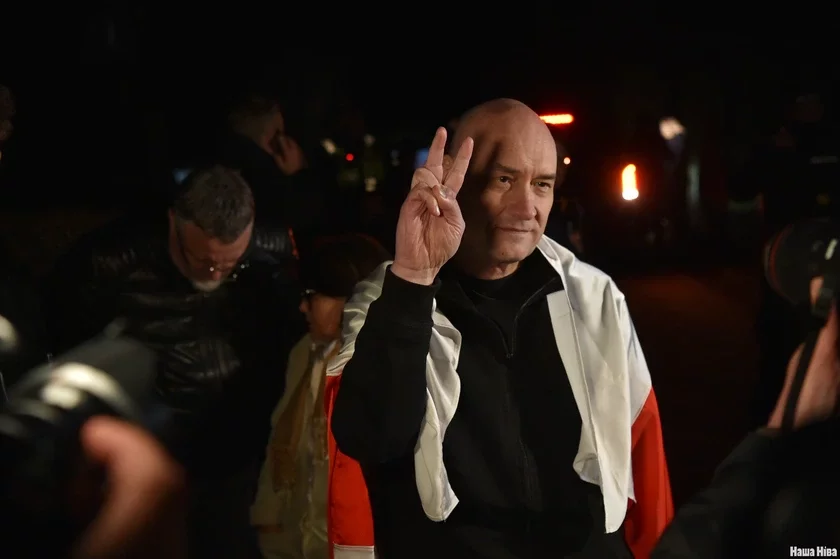
    Valiantsin Stefanovich, deputy chairman of Human Rights Center Viasna, was detained on July 14, 2021, along with Ales Bialiatski and Uladzimir Labkovich. On March 3, 2023, he was sentenced to 9 years imprisonment. He served first in Mogilev correctional colony No. 15, then for roughly the last year and a half in Mogilev closed prison No. 4. He was released and taken out of Belarus on March 19, 2026.

    Timeline

    14 July 2021 – detention

    Stefanovich points out that in 2021, most of the office staff had left, but he—along with Bialiatski and Labkovich—stayed behind; “that was our decision.” They were detained by the Department of Financial Investigations: “the officers were polite—unlike GUBOPIK.” The “funniest part,” he adds, was his son’s toy pistol. Regarding the money and the filming, he puts it in these exact words:

    They confiscated my personal money – about a thousand euros. I said: “This is the last money the family has, our family budget, I have three children.” They took both the money and the white-red-white flags. Moreover, all this was beautifully laid out on the table and filmed: flags, money, and a pistol. I said: “Excellent picture – they found a revolver with a human rights activist too!”

    I asked: “Let me say goodbye to my family.” “Oh, come on, you will be home soon, we will just have a formal chat.”

    Next sentence unchanged: “I said goodbye, hugged my wife and children – and that was it, for almost 5 years.”

    Investigation: Articles 243 and 228(4)

    Initially prosecutors used Article 243 Part 2 (DFR detained the group). There were attempts at non-procedural contacts; as a lawyer he demanded a defined procedural status: if not detained he would leave; if detained, produce the order and go to the Investigative Committee with counsel.

    In autumn 2022 prosecutors showed cessation of prosecution under Article 243 together with reclassification to Article 228 Part 4 (smuggling within an organised group, with Viasna treated as a criminal group and a higher sentencing range than Article 243).

    The investigator asked whether he had expected the change; he replied that under the current broad view of law at least it was not a capital offence, “and thank God.”

    2023 trial; sentence on 3 March

    On treatment in court:

    We were treated with demonstrative humiliation. We rode in handcuffs, like everyone on preventative registration, although formally we were not yet on it. We were in handcuffs both in the cage and in the “glass” (isolated booth) between sessions. Handcuffs were removed only when hot food was brought to us, as the process was very long, and they did not take us back to the SIZO. Handcuffs were switched from behind our backs to the front. I tried to argue to them that this fundamentally contradicts the principle of presumption of innocence; it is cruel, degrading treatment.

    He quotes his remark to the judge—”Perhaps it would be better if the court heard the convoy commander as well?”—and observes the proceedings: “This isn’t a court; it’s a total farce and a circus.” According to him, the prosecutor demanded a sentence of 12 years for Ales Bialiatski, 11 years for him, and 9 years for Uladzimir Labkovich; “they knocked two years off for each of us.” Regarding the verdict itself, he offers his own words:

    Here a strange psychological effect occurred: I rejoice, I am happy – they gave me not 11 years, but “only” 9! Then you realize: “Why am I rejoicing?”

    Mogilev IK-15, preventative dossier No. 10 and SHIZO

    They immediately place him on “preventive watch No. 10—’prone to extremist and other destructive activity.’” The interview describes in detail a “provocation on the third day” after his arrival at the penal colony; the remarks are quoted verbatim:

    When you enter the sleeping quarters, you must change into rubber slippers. I put them on. The orderly says: “They are calling you, come for a minute.” I approach the door – the quarantine chief is there. I say: “I am not in uniform, no boots.” – “Come in for a couple of minutes.” I enter. “Why are you not in uniform? Violation.” I received a penalty.

    Continuing verbatim: “They are taking me to the SHIZO—the punishment cell—for the maximum term of 10 days (later increased to 15). It was May 3rd—my wife’s birthday.”

    The heating season was over, but everyone wore quilted jackets; it was cold. They change my clothes, take away my underwear, I remain in my briefs, they give me a uniform with the inscription SHIZO, and put me in a large cell. I could not sleep at all; the cold was so intense! I shivered, did some squats, push-ups.

    He clarifies: in 2023, he “spent 10 days in the SHIZO during almost every month—totaling about two months”; he “also rang in the New Year of 2024 in the SHIZO.” The heading of the corresponding section in the original text cites “20 days in the SHIZO”; however, the detailed account of the first episode specifies 10 days, subsequently extended to 15.

    An example of the absurdity surrounding disciplinary sanctions is a verbatim exchange from an altercation over a soap dish: “You’re allowed to keep the soap, but not the soap dish”—a remark made by the unit chief, as described by the interviewee.

    Then the unit chief (he was an honest man) would simply come and say: “Stefanovich, I need to punish you with SHIZO.” “Understood, citizen chief!” – “And what shall we write?” I said: “Inventory, as usual, or a jargon word – whatever you want.”

    Strict regime: closed prison No. 4

    After disciplinary escalation on the penal colony premises he was resentenced internally to three years prison and transferred to prison No. 4:

    A cell in the basement, no daylight, a 40-minute walk per day, 1 basic unit for “atavarka.” They moved me between different cells; I went to SHIZO several times.

    Release – hints, setbacks, March 18-19, 2026

    I heard about releases. I knew that Tsikhanouski had been released. An officer from the Mogilev GUBAZiK came to me then. I thought: maybe he came to release me? That officer started to bait me: “We transferred Bialiatski to the hospital, Labkovich was released. You are the only one left, enter into a dialogue with us: tell us about Viasna, about Bialiatski, about the volunteers.” I understood everything. I was not tempted by such things; I started to mock him, saying: “And how much time do I have left? Only 4 years! That is fine!” He says: “I see you are still holding up. Bialiatski and Labkovich testified against you, but you do not want to testify against them!” I replied that I know: no one testified against anyone, because I am confident in my colleagues. In short, we parted with nothing.

    At the end of January, a sergeant announced that they would be released the following day and would need to leave the country—”no alternative was mentioned”—followed by a week of fruitless waiting and the sense that they had been “deceived.”

    In February he returned to SHIZO for ten days. On Wednesday 18 March, quoted without cuts:

    On Wednesday, March 18, at 11 oclock, the chief was supposed to make a round of the entire prison. Suddenly, two OMON (riot police) officers in masks burst in, called out my surname and Kuliashous: “You have three minutes to pack!” Everyone asked: “Whats happening?” – “They are leaving!” We packed; I only grabbed my sports uniform and papers.

    They frisked us, conducted a search. There was a premonition, anticipation, but nothing was clear. They put on handcuffs, a hat over my eyes. Two people led me by the arms, as I could not see where I was going. They put me in a bus. They said I was going for investigative measures. We arrived at the SIZO in Kaliadychy (and at first I did not understand what kind of large, completely new prison this was). A lot of authorities – colonel-lieutenant colonels-dogs.

    I recognized Eduard Palchys, but not immediately: they put him, Kuliashou, and me in one cell.

    Next morning they changed clothes, swapped boots for trainers and told detainees to shave. On leaving Belarus for the Lithuanian direction, forest stop (verbatim):

    We drove into the forest near Kamenny Loh, stood for about an hour – as I understood, we were waiting for the American escort. Five cars with diplomatic plates passed, and we sped after them. Moreover, the Belarusian side did not inform us that we were pardoned. They did not ask – do you want to leave Belarus or not? They just brought us to the border.

    Mr. Cole, according to the interviewee, said in English that “it’s all over; we are free”; negotiations were discussed, as was the fact that “250 people who had remained in Belarus were released today.”

    Documents and political overview

    All prison-related items – uniforms, quilted jackets, yellow tags – were taken away. All notes, copies of protocols, the verdict, the referral to prison were not returned; they tore out pages with relatives’ phone numbers from my notebook – I used that notebook to call my family. They did not return our passports; they only issued a certificate – a kind of identity confirmation. A photo with a stamp and it stated that this was Stefanovich. They said nothing: whether we could return, whether we could not – nothing! They simply expelled us from the country, that’s all – without passports!

    It is as if I was in a coma for 5 years, and now I have woken up. And in a foreign country, too.


    An assessment of the country’s political situation—after nearly five years behind bars—boils down, quite literally, to the following:

    What’s happening now is simply a catastrophe – you cannot call it by any other name. Because all categories of civil and political rights and freedoms imaginable have simply been dismantled. Completely. If previously they were limited, but one could, relatively speaking, pay for cleaning the territory and hold some public action in a park, now nothing is allowed. That is, freedom of speech, thought, assembly, freedom of media – everything has been dismantled. There is not a single opposition political party, no human rights organizations. Democracy is carried out on the basis of the ideology of the Belarusian state. And who wrote it? By whom was it established, why is it mandatory for everyone? This is totalitarianism. This is a catastrophe.
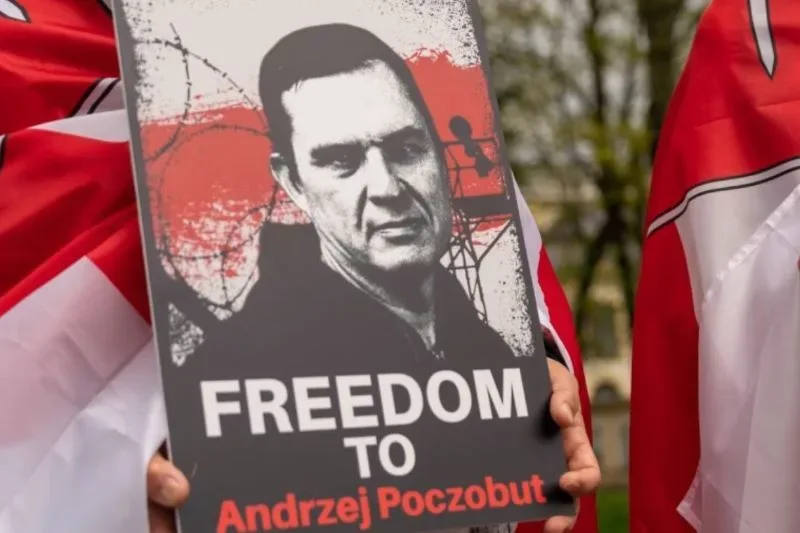

  • “If they lock me up again—well, then I’ll do the time.” Andrei Pochobut on Freedom, death row, and the right to return.

    “If they lock me up again—well, then I’ll do the time.” Andrei Pochobut on Freedom, death row, and the right to return.

    Polish-Belarusian journalist and activist Andrey Poczobut was released on April 28, 2026, after more than five years in prison and a penal colony, and 1,860 days—as he counts them from the day of his arrest. For decades his name was associated with pressure on Poland’s minority in Belarus and on independent journalism there; now, at liberty, he talks in detail about solitary confinement, living next to a death-row wing, courtroom humiliation, and why he at first refused to leave Belarus in a night convoy—until he was promised he could legally return home.

    Who Poczobut is and why his case is “political by definition”

    Poczobut was born in Belarus, retained Belarusian citizenship, and lived for many years in Hrodna, where he was a prominent figure in the Union of Poles. At the same time he worked as a correspondent for Poland’s influential Gazeta Wyborcza—reporting on provincial Belarus, regional history, and minority issues that the authorities treated as a “political trail.” Before his latest arrest in 2021 he had already faced pressure from security forces after the 2010–2011 protests: fines, short detentions, and the threat of a suspended sentence over publications about the regime. Human rights defenders in the EU and Polish officials portray the present charges and eight-year sentence as payback for his words and his ties to the Polish community, rather than as an ordinary criminal case.

    A “five for five” exchange: diplomacy where resolutions helped little for years

    According to BelTA’s summary, release was the outcome of prolonged contacts between the Belarusian KGB and Polish intelligence; the process was described as especially difficult. The exchange took place at the border, formally as “five for five.” Polish officials also publicly linked the breakthrough to firm US engagement and cited the role of President Trump’s administration and the special representative on Belarus. The first footage of Poczobut abroad was published by the Polish-Belarusian “Svaboda” newsroom: a Gazeta Wyborcza correspondent asks him to speak to readers—he talks about people’s “resilience” and what they do.

    Timeline: from arrest in Hrodna to Navapolatsk colony

    March 2021 — a new arrest. January–February 2023 — trial and verdict: eight years in a strict-regime penal colony under articles of the Belarusian Criminal Code which, in independent media’s shorthand, amounted to harming “national security” and incitement to hatred (Articles 361 and 130).

    The sentence was served in Navapolatsk correctional facility PK-1, which journalists and the UN had written about for years: harsh regime, frequent disciplinary isolation, limited family access. Weeks before his long-form interview Novy Chas quoted the deputy head of the colony as saying something like “They needed him alive, not dead.” Poczobut is ironic: nonetheless they barely cared for his health; to fight exhaustion he relied on physical exercise in the inhuman conditions of his cell—and his weight eventually fell almost to a critical level for him.

    No plea for mercy and no “forever” departure

    Novy Chas notes earlier patterns—release tied to a plea for clemency or emigration. Poczobut repeatedly rejected those terms, insisting on counting as a political figure on Belarusian soil without a humiliating deal with the administration.

    Trial, verdict, and the “Battle for Pride” in the courtroom

    A trial of a journalist on political charges is almost always staged for the cameras. In an interview with Nasha Niva (retold for Gazeta Wyborcza) Poczobut reconstructs being told to stand with his back to the gallery “for video protocol”; he refuses—looking at people so as not to lose even small moral ground. Years later he calls that kind of refusal part of preserved dignity—not where the sentence is written down, but where they try to turn you into voiceless courtroom furniture.

    Death-row wing, punishment cells, and physical limits

    The calendar was not the only torture: the cell itself mattered. Poczobut described being held in a block next to death-row cells: you hear voices and know people on the other side of the wall are not serving an abstract “regime sentence” but are in the last stretch of verdicts before execution—the psychological strain for anyone sane is enormous.

    He spent roughly 167 days total in disciplinary isolation (DSI): bare boards instead of a bed, calorie-poor mash, cold summer and winter from an open vent window. He said he stayed in shape with exercise—including sets of up to 140 push-ups. Weight fell from 93 to 74 kg over investigation and imprisonment. Sources agree—including Novy Chas and Nasha Niva.

    The night of departure: “I won’t go without guarantees”—and the right to be home

    When the night convoy said they were taking him to Poland, Poczobut first stopped them: he wanted officials from both sides and a verbal assurance he could return to Belarus. It is reported that a representative from the presidential administration arrived and commitments were relayed via the Polish side. For a journalist who has always anchored himself in the west-Belarusian story of events, that is no bureaucratic trivia—it restores the meaning of a life stripped by the regime of the word “traitor.”

    In a video comment for Svaboda he tells the audience to “stay steadfast in what you believe,” and speaks cautiously about his health on the outside—that doctors say he is doing “better than expected.”

    Poczobut’s case is not a petty wrong the public could shrug off long ago. It is how the state machine turns against unwelcome speech, minority rights, and people who openly write about Polish history on Belarusian soil. When the regime briefly lets a hostage go, an editorial obligation is not only to celebrate but to record how the pressure worked and how refusal to break sounded—before the facts blunt the audience’s memory.

  • Former political prisoners turned to UN experts over persecution for “disobedience” in penal colonies

    Former political prisoners turned to UN experts over persecution for “disobedience” in penal colonies

    Lead. Activists released from Belarus—and those forcibly expelled—have put Article 411 of the Criminal Code (“malicious disobedience” toward a penitentiary administration) in the public spotlight. By their account, the provision turns disciplinary incidents into grounds for new prison terms and creates a risk of de facto open-ended extension of detention. Mandate holders of the UN have in parallel raised the same article in official communications to the Belarusian authorities; the human rights center Viasna links the practice to breaches of the International Covenant on Civil and Political Rights (ICCPR).

    Vilnius, 22 December 2025: what former inmates said

    According to Pozirk, former detainees who were released and expelled from the country held a press conference in Vilnius. Uladzimir Labkovich, coordinator of the “Human Rights Defenders for Free Elections” campaign, described each facility as having “its own specialities in how pressure is applied” and singled out Prison No. 8 in Zhodzina, where, he said, charges under Article 411 are widely used—a norm that “in effect allows sentences to be lengthened.”

    Labkovich said he was interrogated under criminal articles other than those in his original verdict, and that in Zhodzina prison he was reportedly told outright that “they would arrange Article 411” for him by a certain date. As quoted in the piece: “That’s why even at the moment I was being released, until the very last moment I didn’t know I was getting out.”

    Maksim Senik, a trade union member at “Hrodna Azot,” explained how add-on terms work (up to one or two extra years depending on the “gravity” of the original sentence) and stressed that convictions under this head can be repeated—“right to the grave,” in the tone of the report.

    What UN mechanisms have already done

    Regardless of the Vilnius event, the UN Working Group on Arbitrary Detention and special rapporteurs addressed Article 411 in official communications to the Belarusian government.

    The document states that Article 411 “in practice allows for indefinite deprivation of liberty” because the same person can be convicted repeatedly (including while still serving the original term or immediately after it). It names Siarhei Dziatsuk, Mikalai Dziadok, Dzmitry Kazlou, and Zmitser Dashkevich; it says that after the 2020 protests at least 66 people recognized by rights defenders as political prisoners received additional terms under this article. The experts express grave concern about the “broad and vague” wording and link abuse of disciplinary sanctions (disciplinary cells, PKT) to Belarus’s obligations under the ICCPR and the Convention against Torture.

    Figures and Viasna’s legal position

    According to Viasna / Radio Svaboda, since 2020 no fewer than 71 political prisoners have been sentenced to a new term under Article 411. The group’s lawyers tie this to violations of ICCPR Articles 7, 9 and 14. The overview lists typical grounds cited in verdicts: petty breaches of internal rules, refusal of certain kinds of work, and the like; it notes that the same conduct is first treated as a disciplinary breach and later as a criminal offence under Article 411.

    Context in 2026

    UN experts’ statements on the Belarusian prison system as a whole continued into 2026—for example in summaries such as Euronews—alongside wider discussion of disciplinary isolation and pressure on inmates.

  • Belarus adds the YouTube channel vDud to the national list of extremist materials

    Belarus adds the YouTube channel vDud to the national list of extremist materials

    On 30 April 2026, the Ministry of Information of the Republic of Belarus updated the national register of extremist materials and included the entire YouTube channel vDud run by journalist Yury Dud. The channel has more than 10 million subscribers. The underlying ruling was issued on 27 April 2026 by the Zheleznodorozhny (Railway) District Court of Vitebsk, as reported by independent outlets citing the ministry.

    What the decision means

    • The listing covers the whole channel, not individual videos: in practice the full back catalogue and future uploads on that YouTube resource fall under the restriction until the entry is removed from the register.
    • Entries are added to the register on the basis of court decisions; the update was published in the Ministry of Information’s usual procedure (source: Ministry of Information of Belarus).

    Context: the episode with Maria Kolesnikova

    The court ruling and the register update come roughly two months after a long interview with Maria Kolesnikova appeared on vDud — a prominent figure in the 2020 protests in Belarus and one of the symbolic faces of the country’s opposition. The chronological link, as independent media sum it up, is that the authorities acted “two months after the interview was published on the channel.”

    Link to the video: YouTube — interview.

    The reasoning section of the court judgment was not laid out in the open press in the materials referenced here: publicly available information is essentially the fact that extremist status was attached to the channel as a whole and the wider political and media context around Kolesnikova.

    Not the first time: individual videos were already listed

    In March 2022, a court in Minsk declared three videos that had appeared on Dud’s channel and concerned Belarus to be extremist. Their titles were:

    • Nexta: the flagship media outlet of the Belarus protests;
    • Komissarenko: a new life after the Belarus protests;
    • How do you live if your homeland is taken away?.

    The new decision widens enforcement from singled-out episodes to the entire channel as one listed resource.

    What it means for users inside Belarus

    Listing is not about a “moral verdict on YouTube” but about administrative and criminal exposure when people interact with the content on the territory of Belarus:

    • Dissemination: reposting, forwarding links, downloading or re-uploading, public screening, or other circulation of listed material is treated under current rules as dealing with “extremist” content.
    • Subscription and possession: according to human-rights defenders and reported court stories, subscribing to a resource after it is entered in the register, as well as holding such materials, has already triggered administrative proceedings (fines or short arrests, depending on the case).
    • Funding: donations or other support to channels once they appear in the register may in principle provide grounds for criminal charges (each episode is decided by investigators and judges); lawyers generally advise against sending money to such channels from Belarus when in doubt.

    Liability always depends on the exact articles of the Criminal Code and the Code of Administrative Offences cited and on the evidence; the wording above summarizes typical cautions from watchdog groups regarding the national list.

    Yury Dud and Russian law

    Separately from the Belarusian register, Dud is listed as a “foreign agent” in Russia (Ministry of Justice registration from 2022 is noted in summaries). On 14 November 2025 a justice of the peace sentenced him in absentia to one year and ten months in a general-regime penal colony under Article 330.1 of the Criminal Code (failure to meet foreign-agent labelling obligations), as Zona Media and others reported. That Russian case does not supply the legal basis for the Belarusian vDud listing, but it is part of the same regional pressure on independent media.

  • «Chernobyl Way»: 40 years since the disaster and a march against forgetting

    «Chernobyl Way»: 40 years since the disaster and a march against forgetting

    Chernobyl Way is an annual procession of Belarusians on 26 April, marking the anniversary of the accident at the Chernobyl nuclear power plant in 1986. It was held for the first time in 1989. In 2026, 40 years will have passed since the day of the accident — a special reason to remember those the event took or maimed for life, and the lie of the immediate aftermath, when for weeks people learnt the truth largely from others’ reports abroad.

    What «Chernobyl Way» means

    It is a pairing of time and the body politic of Belarusians: on the night of 25–26 April 1986, the fourth reactor unit at the Chernobyl NPP exploded. A radioactive cloud drifted with the wind across many Soviet republics, but the blow was especially heavy for the Byelorussian SSR — thousands of villages and towns fell into zones of elevated contamination because of the weather and how fallout was carried and deposited.

    For weeks, the authorities remained almost silent; people pieced together the scale from official and unofficial sources outside the country. That line of concealment (“everything is under control”, when people had no control over their own daily lives) became one of the reasons people have been marching for decades: memory instead of evasion, honesty instead of Soviet and post-Soviet official lies.

    The first marches and why 26 April

    In 1989, a mass procession was held for the first time and later became a fixed tradition: the date is tied directly to the anniversary of the tragedy. Since then, for many years civic activists, participants in alternative movements and ordinary fellow countrymen have gathered on 26 April in the capital or in diaspora cities — to remember the victims, stand with those resettled from contaminated lands, and insist on naming the danger of radioactive zones as it really is.

    What to keep in mind in 2026

    • Forty years since the releases is a reminder that the effects of radiological contamination and the state walking away from dealing with those effects are not a story of “a single day” on the calendar, but a long arc.
    • The “Way” is also a path against forgetting how symptoms were brushed aside, how information and decisions for people on the ground were delayed.
    • For today’s exile and scattered Belarusian community, these traditions help maintain cohesion: commemorative rallies and marches in capitals and towns of the USA, Europe and elsewhere become a counterpart to something that inside the country fewer and fewer people can say aloud in the same way.

    On this anniversary it is more honest to speak of a grim date — the dead and the sick, the villages wiped off the map, and the shortage of coherent, evidence-led environmental policy. The lie of 1986 (weeks of silence, late evacuations, downplaying scale for the bureaucracy instead of frank guidance to parents) sets a harsh standard for the present: whenever facts are spun again, the Belarusian custom of 26 April remains one of the public anchors where people say: we remember how it really was.

  • 30 years of “Viasna”: behind the date stand not a chronicle, but human lives.

    30 years of “Viasna”: behind the date stand not a chronicle, but human lives.

    On April 26, 2026, the Human Rights Center “Viasna” turns 30. Behind this round date stand thousands of appeals, lists of repressions, letters to political prisoners, and the lives of people who made “Viasna” what Belarus and the world know it to be: from the “Viasna‑96” campaign to the 2022 Nobel Peace Prize for its founder Ales Bialiatski, and to its current work in exile.

    How Viasna was born

    The organization emerged in April 1996 as the “Viasna‑96” initiative in response to the brutal crackdown on that spring’s protests and the mass detentions that followed: someone had to help those arrested and their families. On June 15, 1999, the center was officially registered in Minsk under the name Human Rights Center “Viasna”; ever since, the movement’s website has been spring96.org. Over the years, Viasna has grown into one of the key NGOs in the region — monitoring human rights violations, supporting political prisoners, and working on the death penalty, torture, and elections.

    Awards and the price of repression

    Here are some of the key awards Viasna has received in recent years:

    The price — criminal cases, searches, prison sentences, and the organization’s 2023 designation as an “extremist formation,” after which any cooperation with Viasna from inside the country formally became a criminal risk for ordinary citizens.

    2026: an anniversary in Warsaw

    On April 21, 2026, the Museum of Free Belarus in Warsaw hosted a celebration of Viasna’s 30th anniversary. Ales Bialiatski spoke about how the organization has rebuilt its work in Poland: the core team operates out of Warsaw (with parts of it in Vilnius and Białystok), and — after five difficult years of prisons and emigration — a new generation of “Viasna people” is stepping in. On April 26, Belarusian Radio Racyja (Poland) published a conversation with Uladzimir Vialichkin on the evolution of repressions in Belarus.

    Behind this date there is not merely a chronology of events, but lives: of those who wrote the chronicle of repressions from behind bars, of those who stayed in the country under threat, of those who left and now keep the spring96 line running, and of those whose names are searched for every day in the lists on the website and on Telegram.

    What is worth remembering

    Thirty years is an occasion to recall the unbroken continuity of solidarity: from parcels passed into pre‑trial detention in 1996, to the documentation work of 2020–2025, to the global visibility of Belarusian human rights defense. Viasna continues its path after dissolution and imprisonments — April 26, 2026, is a date about people, not only about an organization.

  • “This leaves people effectively rightless.” UN condemns Belarus for invalidating passports of exiled citizens

    “This leaves people effectively rightless.” UN condemns Belarus for invalidating passports of exiled citizens

    On 20 April 2026, the UN Group of Independent Experts on the Situation of Human Rights in Belarus issued two parallel statements: one on “deeply alarming” practices inside Belarusian prisons and another statement strongly condemning the invalidation of passports of former political prisoners forcibly expelled from the country in 2025 and 2026. The experts say such measures are contrary to international law, leave people “effectively rightless,” increase the risk of statelessness, and must be reversed immediately.

    What exactly the UN said

    In the press release by the UN Office of the High Commissioner for Human Rights (OHCHR) and the accompanying statement of the Group of Independent Experts, it is emphasised that the Belarusian authorities have declared invalid the passports of people released from prison and forcibly removed across the border — primarily to Lithuania — without legal grounds or any proper justification.

    “Invalidating a passport constitutes a legal violation when such action is arbitrary, discriminatory, disproportionate, or lacks a clear legal basis or due process,” the Group said in its statement.

    The experts recall that such practices breach several norms of international law at once: the Universal Declaration of Human Rights and four articles of the International Covenant on Civil and Political Rights — freedom of movement, the right to enter one’s own country, the right to recognition as a person before the law, and the principle of non-discrimination. The statements also refer to the 1954 Convention relating to the Status of Stateless Persons and the 1961 Convention on the Reduction of Statelessness — two treaties Belarus agreed to ratify during its 2020 Universal Periodic Review.

    What it looks like in people’s lives

    UN experts interviewed a large number of former political prisoners. The consequences they describe are far from a mere formality:

    • inability to return to Belarus and forced separation from families;
    • difficulties in obtaining legal status in host countries;
    • restricted access to work, healthcare, housing and education;
    • prolonged legal uncertainty and a real risk of ending up stateless.

    As REFORM.news reports, among those whose passports were already declared invalid in March 2026 is the Nobel Peace Prize laureate and founder of the Human Rights Center “Viasna,” Ales Bialiatski.

    Context: where “invalid passports” come from

    The UN statement continues a longer line of concern. Already in December 2025, independent UN experts had condemned the forced expulsion itself: on 11 September 2025, under an agreement with the United States, Belarus released from prison and brought to the Lithuanian border 52 people — mostly Belarusian citizens: politicians, journalists and trade unionists. According to the UN, 14 of those expelled had their identity documents confiscated, one held an expired passport and another a passport with torn-out pages. Opposition politician Mikalai Statkevich refused to cross the border and subsequently disappeared.

    The legal framework for these measures is a system built up over recent years:

    • the 2022 and 2023 constitutional and legislative amendments, which allow the revocation of citizenship of those convicted in absentia of “extremism” or “causing serious harm to the interests of Belarus” — without a fair trial;
    • the 2023 Presidential Decree on consular services, which effectively ended the issuance and renewal of identity documents for Belarusians abroad through consulates.

    “This is yet another measure taken by Belarusian authorities which leads to a risk of statelessness,” the UN experts stressed.

    In parallel — a statement on prisons

    On the same day, 20 April 2026, the Group of Experts also released a separate statement on “deeply alarming” practices in Belarusian penal colonies: torture, prolonged isolation, deaths and serious injuries of inmates. The experts call on Minsk to guarantee humane conditions of detention, ensure access to independent medical and psychological assistance, and conduct proper investigations of all deaths and serious injuries in places of deprivation of liberty. According to the Human Rights Center “Viasna”, more than 1,100 political prisoners are still being held in Belarusian prisons.

    What the UN is demanding

    The Group of Independent Experts addresses the Belarusian authorities with a concrete set of demands:

    • immediately remedy the situation with invalidated passports and restore the rights of the individuals affected;
    • stop adopting and revoke all measures that create a risk of statelessness;
    • review anti-extremism and counter-terrorism legislation, which the experts consider incompatible with international human rights law;
    • ensure humane conditions of detention and independent medical access for political prisoners.
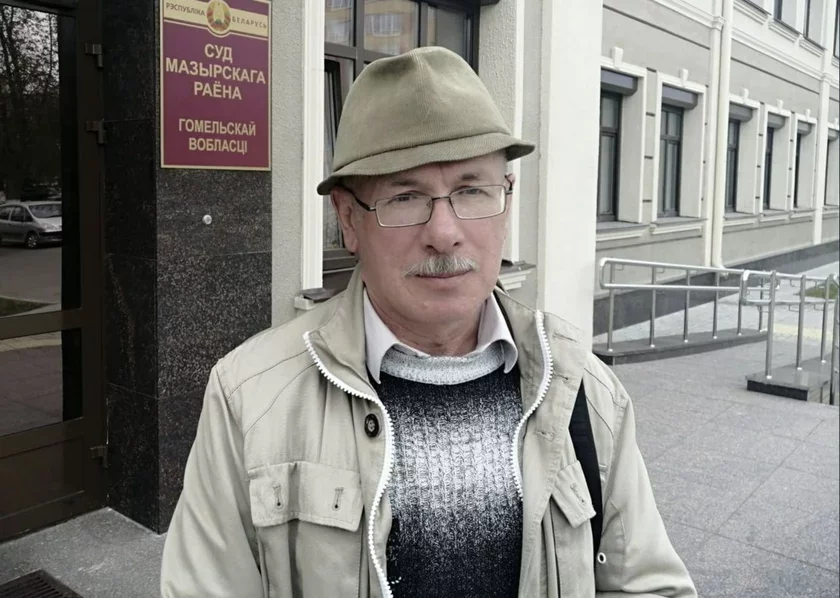
  • Human rights defender Vladimir Telepun detained in Mazyr

    Human rights defender Vladimir Telepun detained in Mazyr

    Mozyr human rights defender and Chernobyl disaster liquidator Vladimir Telepun was detained on 17 April 2026. He is believed to be held in the temporary detention facility (IVS) of the Mozyr district police department (ROVD). The exact reasons and legal basis for his detention are still being clarified.

    Chronology of pressure

    December 2021 — According to Zerkalo, searches were conducted at his dacha and apartment. Wider reporting at the time also covered raids against human rights defenders in that period.

    6 September 2022 — Ten days’ arrest for a link on Facebook to the human rights site Paleskaya Viasna (Paleskaya Spring). An ambulance was called at the court hearing: the rights defender had missed taking his blood-pressure medication; security officers refused to pass on medication brought by relatives. Before the end of the term, three new administrative reports were drawn up; another search was carried out at his home; he was released on 1 October 2022.

    16 November 2023 — Another detention; in Nasha Niva’s reporting, the motive is linked to preventing him from attending an appointment with a judge of the Constitutional Court at the Mozyr district executive committee. After three days he was released from the IVS without a trial.

    January 2025 — According to Nasha Niva, 15 days’ arrest under part 2 of article 19.11 of the Administrative Offences Code (“dissemination of extremist information”); it was reported that he spent his 73rd birthday in the IVS.

    Key facts of his work

    Human rights work: He is part of the region’s human rights community and has repeatedly spoken out in defence of civil rights.

    Defence of the “Rainbow” centre (2019): He actively supported families raising children with disabilities in the fight to keep the “Rainbow” (Raduga) rehabilitation centre in Mozyr open, as the authorities had sought to curtail its work.

  • Photographer Aliaksandr Shishko detained at Minsk airport on return from Georgia

    Photographer Aliaksandr Shishko detained at Minsk airport on return from Georgia

    On 14 April 2026, photographer Aliaksandr Shishko was detained at Minsk National Airport. The information was published on the DissidentBY project website; rights defender Roman Kislyak confirmed it for Pozirk.

    Aliaksandr had lived in Tbilisi since at least 2022. Why he returned to Belarus is hard to say; perhaps he missed his homeland and his family. I think he misjudged the risk of being detained — he thought he would slip through.

    — Kislyak said.

    The rights defender noted that after Freedom Day 2024, propagandists began mentioning Shishko in their materials.

    As far as I know, a criminal case was opened over holding Freedom Day events abroad, and as part of that case his apartment in Belarus was searched.

    — Kislyak added.

    According to summaries in independent media, reports also raise the issue of restrictions on disposing of the photographer’s housing (alongside the practice of sealing flats in criminal cases). Shishko’s name appeared in an ONT segment with host Ihar Tur on the seizure and sealing of property belonging to activists who had left the country: the on-air list included, among others, Aliaksandr Shishko and others; as critics of the broadcast recounted, the flats were sealed in the context of criminal cases (Nasha Niva).

    Authorities in Minsk routinely threaten criminal prosecution against participants in public actions abroad.

    In autumn 2025, independent outlets reported mass detentions on entry into Belarus; open sources cited figures on the order of a hundred or more cases — totals may be higher depending on how they are counted. Viasna Human Rights Centre and partners regularly receive reports of questionings and detentions at Belarusian border crossings and airports, a pattern that has continued for several years.

    Chronicle of political persecution — 14 April

    In Belarus, detentions and raids continue, as do administrative and criminal trials; there are reports of harsh conditions in detention facilities and pressure on political prisoners; independent media products and initiatives are still added to lists of “extremist” materials and formations.

    On 14 April 2026, the Viasna Human Rights Centre and related channels continue to collect and publish facts of politically motivated persecution of Belarusian women and men — as an updating chronicle (including via spring96.org). Information is added as new data comes in.

    The story of Aliaksandr Shishko’s detention at the airport fits this pattern: return from abroad, prior attention from security structures to his person, and a criminal line tied to the public agenda of emigration and Freedom Day.

  • Security forces visited ZROBIM Architects’ Minsk office two days in a row: what we know

    Security forces visited ZROBIM Architects’ Minsk office two days in a row: what we know

    ZROBIM Architects—one of the most prominent firms in the Belarusian market, with a strong international profile—was in the crosshairs of law enforcement on two consecutive days. On 9 April 2026 the story was a mass raid with on-site detentions; on 10 April investigators appeared to be operating on the logic of picking up those who had not been there the day before.

    Timeline (according to independent media)

    Morning of 9 April. Officers from the Financial Investigations Department (references in reports mention the Department of Financial Investigations) came to the Minsk office. Around 11:00, various bulletins spoke of dozens of people detained right at their desks—press figures hovered around 50–52. Some reports mentioned blocking or loss of access to an internal server. Among those detained was co-founder Andrei Makouski; the second co-founder, Aliaksei Karableu, was reportedly not living in the country at the time (United States), according to media.

    10 April. Security forces were in the office again. Per Belsat and Charter 97, employees were summoned to the premises, and people were detained including those who had not been present during the first raid—the feed included wording along the lines of “detaining everyone who wasn’t here yesterday.” Most of those detained the previous day had been released by then, but the criminal-procedural backdrop and the status of individual figures, including Makouski, remained unclear in open sources—this should be checked against the latest updates from human rights defenders and relatives.

    Theory of motive: a post about an “ideologist”

    There is little in the way of a single official comment from the authorities in the material reviewed. REFORM.news and other outlets quoted a pro-government Telegram channel: it linked the raid to a post by Makouski on Threads describing a demand from state bodies for a full-time “ideologist” at the company. The channel’s tone was accusatory (“shouldn’t have cracked jokes…”), framing the episode as a political-ideological clash, not merely a “tax inspection.”

    Separately, the AP notes a wider context: Belarus has seen more actions against independent professional circles, including use of criminal law and mass search practices.

    About the studio

    ZROBIM has operated since 2011, delivers projects in Belarus and abroad, and has repeatedly been noted in international competitions (reports have cited, among others, an IIDA Global Excellence Award 2025 for an educational project in Novaya Barovaya).

    Bottom line

    This was not a one-off “swoop” but a two-day operation involving mass detentions and technical pressure (the server). In the public narrative the cause is explained through the dispute over the manager’s post about an in-house ideologist; the legal qualification and outcome for each person involved remain opaque to readers for now.