Author: Yana Zmagar

  • “BYSOL couriers”: Minsk City Court sentences four Minsk residents

    “BYSOL couriers”: Minsk City Court sentences four Minsk residents

    On 17 February 2026, Minsk City Court handed down sentences against four residents of the capital whom the investigation treated as participants in an “extremist formation” — the BYSOL solidarity fund. According to the prosecution’s account, they acted as couriers, receiving and passing on money to other participants in the scheme. BYSOL representatives reject that model. The court imposed on the defendants between two and three years’ imprisonment, substantial fines, and confiscation; according to legal summaries, the judgment entered into force.

    Charges

    All four were tried under Article 361(3) of the Criminal Code of Belarus (participation in an extremist formation). One woman was additionally charged under Article 342(1) — participation in actions that grossly disturb public order. Independent media covered the proceedings and the legal classification; the Viasna Human Rights Centre also referenced the case on its channels.

    The prosecution’s version

    The investigation, as quoted by outlets, described joining the scheme no later than June 2024 and operating for about five months: collecting and transferring funds and distributing them in the interests of participants in “protest” and “extremist” activity. Coordination allegedly took place via correspondence with people abroad, using coded wording and minimising face-to-face contact. Over the period in question, case materials cited sums on the order of €2,000 and US$1,100 (as movement of funds within the alleged scheme). According to mlyn.by, two defendants admitted guilt and expressed remorse; two denied guilt.

    Sentences and property penalties

    • Two defendants were sentenced to 2 years’ imprisonment;
    • two — to 3 years (including the woman with the additional charge);
    • each was fined 500 base units (media conversions cite roughly 22,500 Belarusian roubles);
    • confiscation of mobile phones and money was ordered; some reports add recovery of more than 10,000 roubles as proceeds of crime.

    BYSOL’s position

    In comments to Euroradio, the fund said it does not use couriers to move money inside Belarus and treated the charges as part of pressure on solidarity initiatives. Readers should distinguish criminal qualification under Belarusian law from judgment of the organisation itself: under Belarusian rules BYSOL is classified as an extremist structure, which in itself affects the legal status of any “assistance” involving it on the territory of the country.
  • “Year of the Belarusian Woman” — 2026: Decree No. 1 and the question of political prisoners

    “Year of the Belarusian Woman” — 2026: Decree No. 1 and the question of political prisoners

    President of Belarus Alyaksandr Lukashenka signed Decree No. 1 of 1 January 2026, declaring the current year the Year of the Belarusian Woman. In the official framing, the document aims to shape a “national image of the woman as a worker” and to promote women’s role in preserving and developing society. A broad campaign runs in parallel: family, health, media, and public events. The response from the opposition and human rights defenders is predictable: against the backdrop of hundreds of political prisoners in the country and dozens of women behind bars, such declarations are described as a gap between words and practice.

    The critical line

    In outlets such as BBC Russian, public pushback rests on names and numbers: reminders of women political prisoners, heavy sentences, and conditions in pre-trial facilities and colonies. The argument is not that “women should not be celebrated,” but that criminal prosecution for dissent and civic stance — including against women — undermines trust in official “care.” For the current prisoner count and gender breakdown, newsrooms should check spring96.org and specialised projects (belaruswomen.org, etc.) as of the publication date.

  • December 2025: repression did not stop

    December 2025: repression did not stop

    Even in a month of high-profile pardons, Belarusian human rights defenders continued to record new detentions, searches, and interrogations. According to Viasna’s tallies, December 2025 alone saw more than 80 documented episodes of politically motivated pressure. In parallel, the figures for the whole of 2025 reflect a different order of magnitude — at least 1,254 people who went through the courts on politically motivated criminal charges (this is a minimum estimate: some trials are closed to observers).

    What counted as “repression” in December

    December monitoring captured not only short administrative detentions but also raids, summons for questioning, and criminal and administrative cases tied to “extremism,” protest-related issues, and public criticism of the authorities. Against that backdrop, rights defenders stress: expanding lists of “extremist” resources and formations creates a basis for new charges.

    REFORM.news, among others, reported on the same period, citing Viasna. By month’s end, hundreds of people whom the centre classifies as political prisoners remained in places of detention; December added new names to that statistic.

    1,254 over the year: the conveyor belt in figures

    The year-end compilation for 2025 (published by rights defenders towards the end of December) shows there was no mass shift to “light” sentences: a large share of people received restriction of liberty without a colony (the so-called “home restriction” [“home chemistry”]), while others got real prison terms in colonies. Article 342 of the Criminal Code (participation in unauthorised mass events) still tops the list by case count — hundreds of defendants; the statistics also feature charges related to “extremism,” insulting the president, “inciting hatred,” calls for sanctions, and others. For a detailed breakdown, see REFORM.news and RFI; the primary source cited is spring96.org.

    Elections and “clearing” the public space

    We do not tie every December detention to a single date on the electoral commission’s calendar: that would require separate court-and-reporting checks for each episode. But the general conclusion of rights defenders and international observers recurs year on year: before and during election campaigns, pressure intensifies on independent media, activists, and informal networks — from school chats to trade unions. In recent years, winter months have repeatedly coincided with votes and waves of inspections; in that light, December’s tally of 80+ cases reads not as “calm after the pardons” but as business as usual.

    Pardons did not end the criticism

    The same December was also marked by the mass release of 123 people under pardons. Viasna and other groups stressed: release often came with forced departure and no realistic prospect of lawful return, alongside unchanged repressive legislation.

  • On 13 December, 123 political prisoners walked free from Belarusian prisons

    On 13 December, 123 political prisoners walked free from Belarusian prisons

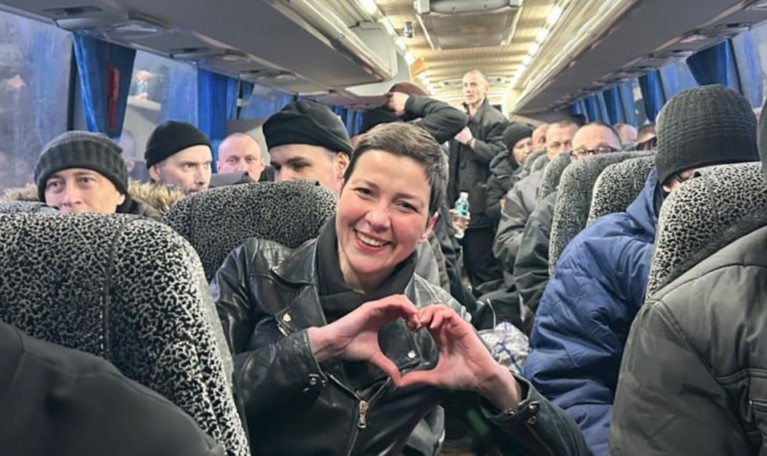
    On 13 December 2025, 123 people were released from places of detention in Belarus. Among them were well-known politicians and human rights defenders, foreign nationals, and people whose health in custody had alarmed relatives and rights groups.

    What happened

    The releases were officially framed as pardons. In public discussion the episode is most often described as part of a major diplomatic arrangement: talks also covered next steps in relations with the United States, including easing restrictions affecting the potash sector — a key pillar of Belarusian exports. That context is highlighted by, among others, the Associated Press, the BBC, and Radio Free Europe/Radio Liberty.

    Some of those freed were moved out of the country: open sources mention transfers toward Ukraine and Lithuania, with individual figures going to other European states. Exact routes and each person’s legal status after release should be checked against fresh reporting and statements by human rights defenders.

    Names that appear most often in the lists

    Public lists include, among others:

    • Ales Bialiatski — human rights defender, Nobel Peace Prize laureate; groups such as CIVICUS flagged harsh detention conditions and health risks;
    • Maryia Kalesnikava, Viktar Babaryka, Maksim Znak — figures tied to the 2020 political crisis;
    • representatives of media and civil society, including people linked to TUT.BY and the Viasna Human Rights Centre.

    Media coverage also notes nationals of several countries (including US allies and Ukraine), underscoring the international dimension of the list, not only its domestic side.

    Health and the “humanitarian” framing

    Official wording linked the decision to appeals by other leaders and humanitarian considerations (Novaya Gazeta and others). For years the rights community had demanded the release of the seriously ill and those denied adequate medical care in colonies. For many families, this wave of releases meant the legal act of pardon coincided with hope for proper diagnosis and treatment outside pre-trial jails — even at the cost of forced emigration or an uncertain status abroad.

    What lies beyond a single day’s headlines

    One mass release does not dismantle the system of political prosecution: open tallies still showed hundreds whom rights defenders count as political prisoners. In early interviews, several of those freed spoke of guilt toward those who remained behind bars — a moral tension that, for many, weighs heavier than political headlines.