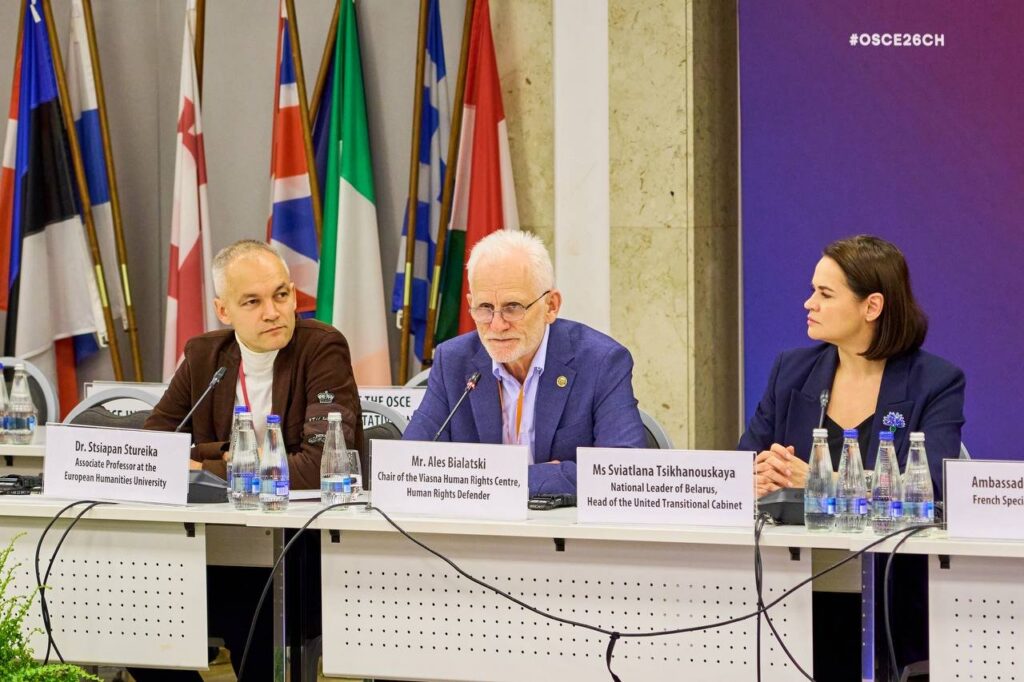
On 14 October in Warsaw, at the OSCE Human Dimension Conference, a side event was held on the Belarusian language, culture and young people. At the table were Nobel laureate Ales Bialiatski, leader of the democratic forces Sviatlana Tsikhanouskaya, European Humanities University associate professor Stsiapan Stureika and RADA council chair Aliaksandra Doinich. The opening words were from Patrik Svensson, the Swedish government’s representative to the Belarusian democratic movement in exile.
Who convened it
The conference runs in Warsaw from 5 to 15 October. It is led by Switzerland, this year’s OSCE chair, and the Office for Democratic Institutions and Human Rights. The side event was set for 16:00–17:00, in the Belweder room. The languages were Belarusian and English. It was convened by the informal Group of Friends of Democratic Belarus: about thirty participating states. Latvia’s mission is listed first, with Sweden, Estonia, France, Poland, Lithuania and others beside it. The moderator, according to Tsikhanouskaya’s office, was France’s new special envoy for Belarus, Michel Roux. The nameplate at the edge of the table is the French representative.
The event filing says it plainly. The authorities strike not only at opponents and human rights defenders. They are redrawing the cultural field: language, history and national symbols are increasingly treated as a sign of disloyalty. The 2023 OSCE Moscow Mechanism report recommended preserving and recording the Belarusian language, literature, music, dance and customs. Instead, the organisers write, independent groups are being erased, cultural identity is being criminalised, and the school is held as a tool of ideology and the “Russian world.”
What Tsikhanouskaya said
Her office splits the speech into four themes. First: pressure on culture and historical memory. Education is used as ideological control. Second: Russia is widening its influence on young people through propaganda, schools and cultural projects. Third: the 2023 recommendations on language and culture are still not carried out. Fourth: culture and education have to be held abroad as well — independent media, civic and cultural initiatives, help for people in exile and for youth organisations.
Viasna writes that she had four requests for the states. The first one it names: keep the repression of Belarusian culture and identity on the agenda of the OSCE and the international community, and name these facts in statements, reports and discussions.
Her words, as the office publishes them: “Russia is systematically pursuing a policy of Russification, assimilation and the destruction of everything national, everything Belarusian. With Lukashenka’s help they are trying to turn Belarusians into obedient, loyal people and, in the end, into Russians. But I am proud when I see young people in Belarus recording TikTok videos in Belarusian, making videos for YouTube, discovering the Belarusian language and culture for themselves. As long as the regime fights Belarusian society and culture, the task of the democratic forces is to preserve all of it.”
A language for ordinary days
Doinich, in Viasna’s account, asked that the Belarusian language be supported not only abroad but inside the country. Young people and cultural organisations, she says, keep working, though defending culture and identity carries a risk. The language should be part of an ordinary day, not only of the stage and of a sign of the past. To those who have left she suggests speaking Belarusian with relatives at home and showing that it is an ordinary way of talking, not a rite.
Bialiatski at this meeting is the chair of Viasna and a Nobel Peace Prize laureate. Stureika is an associate professor at the university that works in exile. They were seated to speak on the same field: language, memory, the school. Open write-ups carry fewer lines that can be checked word for word than they do for Tsikhanouskaya. Viasna’s headline took a sentence from the meeting: “The stronger Belarusian society is, the weaker the dictatorship.” The available account does not sign who said it.