He wanted to run for president, and instead received the longest sentence of any political prisoner from 2020. Exactly a year ago, Siarhei Tsikhanouski walked free.
The blogger who became a threat
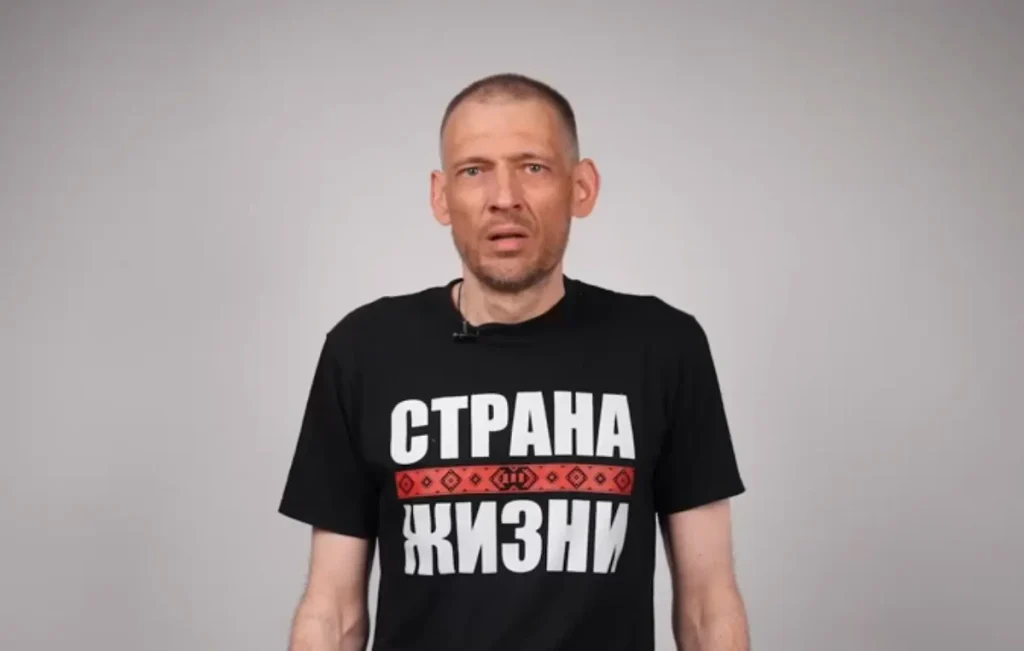
Tsikhanouski rose to fame through his YouTube channel “A Country for Life.” On it, he talked about the problems ordinary Belarusians faced, interviewed local activists, and criticized officials (Novaya Gazeta Europe). The channel grew rapidly: from 140,000 subscribers in May 2020 to 243,000 by mid-July, more than 12 times the audience of the state-run satellite channel Belarus 24 (Wikipedia). Tsikhanouski toured the regions in his own motorhome, and traffic police kept pulling him over, while the blogger himself was repeatedly jailed for days at a time.
How Lukashenko kept him off the ballot
In the spring of 2020, Tsikhanouski announced he was running for president. On May 6, the day after he filed his paperwork, riot police dragged him out of his car on the road, formally to serve an old administrative sentence. Without his personal signature, the Central Election Commission would not accept his documents, so an hour before the deadline his wife Sviatlana registered her own campaign group instead. Soon afterward, Lukashenko publicly called Siarhei “mangy” and said of Sviatlana that Belarusian society was supposedly “not ready” to vote for a woman (Novaya Gazeta Europe).
The arrest: “I gave the signal”
On the evening of May 29, 2020, Tsikhanouski was detained at a signature-collection event in Grodno. According to Novaya Gazeta Europe, two women provocateurs approached him, police appeared in the crowd almost immediately, a scuffle broke out, and within minutes riot police detained Siarhei. The next day, a criminal case was opened against him for violence against police officers, and a few days later security forces claimed to have found $900,000 at the Tsikhanouskis’ country house. A month later, Lukashenko himself admitted the arrest was his decision: “Yes, I gave the signal on Tsikhanouski” (Novaya Gazeta Europe).
That August, on his 42nd birthday, 200 to 300 people gathered outside the Minsk detention center on Valadarskaha Street with balloons and white-red-white flags to wish him a happy birthday (Current Time). In the autumn of 2020, at the height of the protests, Lukashenko came to the KGB detention center to meet several jailed opposition figures, Tsikhanouski among them. Two of them were released after that meeting, but he was not.
18 years
His co-defendants were politician Mikola Statkevich, Ihar Losik, Artsiom Sakau, Uladzimir Tsyhanovich, and Dzmitry Papou. The trial was held behind closed doors inside a Gomel pre-trial detention center, and on December 14, 2021, Tsikhanouski was sentenced to 18 years in an enhanced-security penal colony, more than any other defendant (Zerkalo). It was the harshest sentence handed down over the entire campaign and protests: Viktar Babaryka received 14 years, Maria Kalesnikava 11. Siarhei listened to the verdict standing, but turned his back to the judge (Current Time).
Five years in solitary
While already behind bars, Tsikhanouski was convicted again, this time of “malicious disobedience to the colony administration.” Another year and a half was added to his sentence, and he was moved to a prison regime. For years he was not allowed to buy even soap or a toothbrush. From March 2023, his family received no news of him at all. According to him, the guards told him he would never get out and would die in prison (Novaya Gazeta Europe). He spent five years in solitary confinement and described the conditions as torture (Current Time). Tsikhanouski also said there was no medical care whatsoever in the colony, and that conditions improved only slightly after Alexei Navalny’s death in February 2024 (Zerkalo).
The authorities pushed him to ask for a pardon. According to Tsikhanouski, an assistant prosecutor visited him, followed by Raman Pratasevich, who also tried to persuade Babaryka and Kalesnikava to petition for clemency (Zerkalo). Tsikhanouski refused.
Release
On June 21, 2025, Tsikhanouski was unexpectedly freed after a visit to Minsk by US presidential envoy Keith Kellogg. He and 13 other political prisoners were taken out of prison with bags over their heads and driven to Lithuania. A month before the release, the authorities began fattening him up with butter, cottage cheese, and juice (Current Time). At his press conference in Vilnius he appeared half his former weight, and his daughter did not recognize him until she was told it was her dad (Novaya Gazeta Europe).
Even then, Lukashenko avoided saying his name. On July 3, he called Tsikhanouski “one of the fugitives” whom he had personally released. He claimed the Americans had not even asked for his release because they considered him “pro-Russian,” and that the decision was his own initiative (Nasha Niva).
Where he is now
Once free, Tsikhanouski described himself as a politician. He said he opposed a violent change of power and announced that 500 people had already joined his team, 100 of them from inside Belarus (Current Time). Since December 2025, however, he has all but vanished from the Belarusian media space: he makes no statements, rarely gives interviews, and his channel only occasionally posts routine videos. In mid-May 2026, Sviatlana Tsikhanouskaya said her husband was studying English in the United States (Zerkalo).