Mikalai Statkevich is a Belarusian opposition figure, a former officer and a former presidential candidate. He is described as the political prisoner who has spent more time behind bars than anyone else in the country. He became widely known after September 2025: they took him to the border, and he refused to leave.
Who he is
He was born on 12 August 1956 in the village of Liadna, near Slutsk. A reserve lieutenant colonel and a candidate of technical sciences, he leads the unregistered Belarusian Social Democratic Party (Narodnaya Hramada). Amnesty International has recognised him as a prisoner of conscience three times. After the stroke it called him that again.
Three sentences
The first grew out of October 2004, when he organised a protest against dictator Aliaksandr Lukashenka removing the limit on presidential terms from the constitution. The sentence came on 31 May 2005: three years of corrective labour. An amnesty cut it to two.
The second followed the 2010 election. Like the other candidates, he was detained on 19 December, voting day, after the square was broken up. On 26 May 2011 he was given six years in an enhanced-regime colony for “organising mass riots.” He did not serve the full six: he was pardoned on 22 August 2015.
The third time he was detained on 31 May 2020, on his way to a picket collecting signatures for Sviatlana Tsikhanouskaya, before the mass protests began. First he was given 15 days, then a criminal case was opened. On 14 December 2021 the Homiel Regional Court sentenced him to 14 years in a special-regime colony. The prison was Penal Colony No. 13 in Hlybokaye, the most closed in the country. He was transferred there on 24 June 2022.
In all that time he had one short visit with his wife, Maryna Adamovich — on 1 June 2022. From 9 February 2023 he was cut off from the outside world: no letters, no calls, for more than two and a half years. Novaya Gazeta Europe writes that across the three sentences he served 12 years.
The border, 11 September 2025
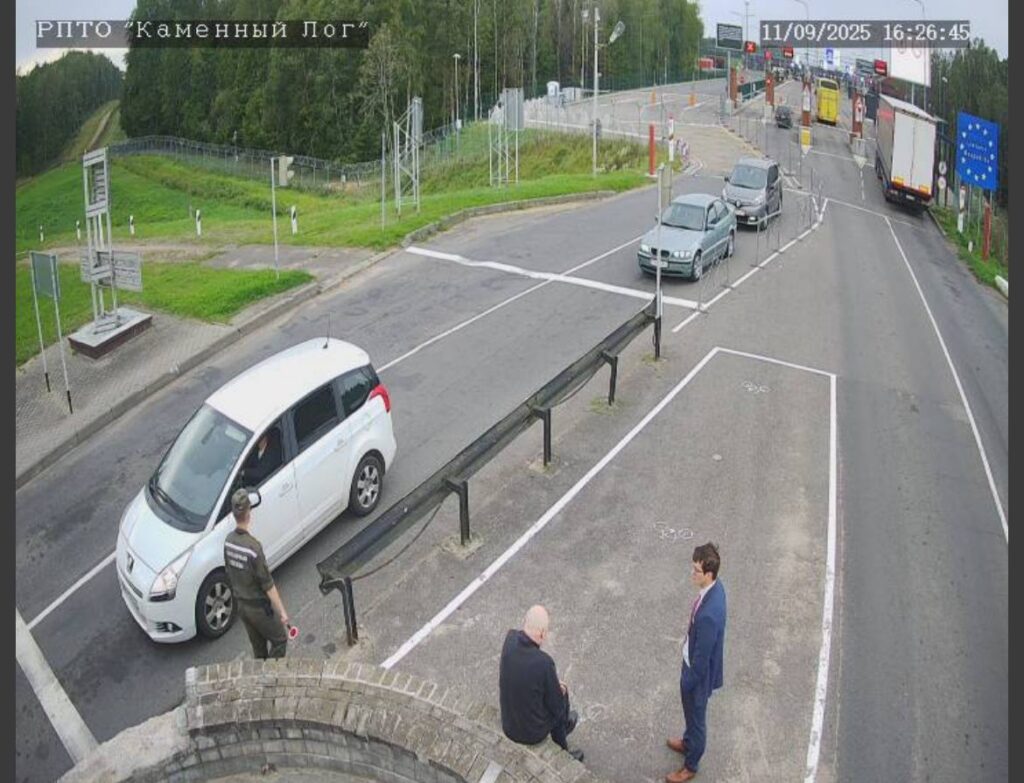
That day 52 political prisoners were freed, Statkevich among them, and taken to the Lithuanian border to be expelled. On the neutral strip at Kamenny Log, Statkevich jumped from the bus — witnesses say he broke the door — and walked back toward Belarus. Maksim Viniarski jumped with him. He later told Novaya that a young border guard said they would not be let in without documents, and a man in civilian clothes urged them to go to Lithuania. Statkevich sat down and stayed. Viniarski walked to the Lithuanian side.
A US embassy employee gave Statkevich a phone so he could call his wife: they expected she would talk him into leaving. Maryna Adamovich was not in the country. She did not try to persuade him to go. She only asked him to wait on the strip so she could hug him. She did not make it in time. He spent several hours at Kamenny Log. At 16:26 the camera still shows him sitting. Then he walked to the Belarusian side. People in masks took him away. Nasha Niva and Novaya Gazeta Europe reported it.
Five months of silence
His wife wrote to the police, the Interior Ministry, the department that runs prisons, the border service and a court. The only answer was a letter of 21 November 2025 from deputy interior minister Henadz Kazakevich: Statkevich “is serving his sentence” under the Homiel Regional Court verdict, with no word of where.
It later turned out he had been returned to the same colony in Hlybokaye. According to Statkevich, as his wife relayed it, he was taken there with a bag over his head and his hands bound — the same way he had been taken to the border. On 21 January 2026 he had a stroke. That evening he was taken to Minsk. He spent three weeks in intensive care and was fed through a tube. Lukashenka’s press secretary, Natallia Eismant, called it a cerebral infarction.
Home, without a certificate
On 19 February 2026 his wife said Statkevich was home, recovering from the stroke, but still speaking with difficulty. Eismant said the pardon had been decided back then, but Statkevich had refused to leave and had returned to prison. This time, she said, he was released at the family’s request because of his health.
His legal status is still unclear. In April 2026 his passport turned up at Pre-trial Prison No. 1. Staff there refused a release certificate: they had “not released” him, they said, but taken him from the prison hospital on a “scheduled convoy.” In the Interior Ministry database, he wrote, he was still listed as a prisoner of Colony No. 13 in Hlybokaye. Without the certificate he cannot draw a pension. Zerkalo and Radio Svaboda reported his account.
He does not intend to leave. The house in Loshitsa fell under the demolition of the private neighbourhood. A city flat was offered instead. On 28 September 2026 Statkevich wrote that he and his wife had moved to a village house near Minsk. No one had lived in it for twenty years.
He keeps speaking in public. On 17 September 2026, on his Telegram channel, he commented on the release of another 25 political prisoners: glad for the people, and sorry that only twenty-five came out, after the American side had spoken of a larger number.