Six years ago, on 27 September 2020, Belarus was on the 50th day of protests. The count starts from the night of 9 August, when the election commission declared dictator Aliaksandr Lukashenka the winner and people did not believe it. Four days before the march, on 23 September, he held his inauguration in secret. That Sunday Minsk answered with a “people’s inauguration” of Sviatlana Tsikhanouskaya.
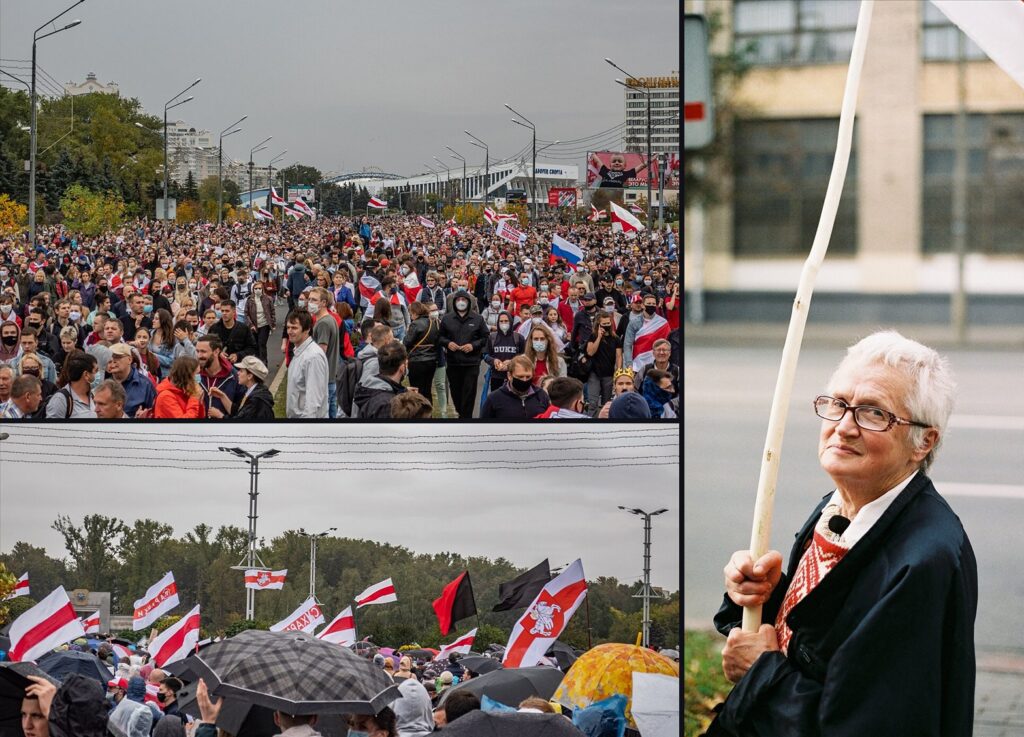
Tsikhanouskaya was not on the avenue. She had been in Lithuania since 11 August. The inauguration was the people’s in the plain sense of the word. The seventh Sunday march was named as the inauguration of the real president. People carried posters with her name, drew her a presidential card, and wore crowns. It was raining. Columns met at the “Minsk, Hero City” stele and walked more than ten kilometres: to the Academy of Sciences and on along Independence Avenue to Uruchcha, to the OMON base. They did not go to the residence that day. The march lasted more than four hours.
Nobody counted the crowd head by head. Interfax correspondents wrote that more than 100,000 came out in Minsk. Radio Free Europe’s Belarusian service passed on the same estimate, about 100,000, citing international agencies. Radio Liberty was more cautious: tens of thousands, and by some estimates more than a hundred thousand. After the march Meduza reported targeted detentions: a preliminary figure of about 200 people nationwide, about 140 of them in Minsk. In Homiel that day police used tear gas and stun grenades.
An oath nobody was told about
The ceremony of 23 September was held at the Palace of Independence. It was not announced. Television was showing serials at the time, although the law requires an inauguration to be broadcast. There were no ambassadors, including the Russian one. A few hundred loyalists were in the hall. That evening people came out in Minsk and in other cities. Security forces used water cannons with dye, beat people with batons, and made arrests. Meduza and the BBC reported it.
How those fifty days began
The protests began on 9 August 2020 because the election was falsified. The election commission gave the victory to Lukashenka. The opposition, independent observers and the people in the street did not accept the result. That night and the nights after, the crackdown used rubber bullets, tear gas, stun grenades and water cannons. Detainees were beaten and tortured. Okrestina became the name of that August. This is not the conclusion of a single report. Rights groups, doctors and journalists documented the torture.
People were killed. On 10 August, Aliaksandr Taraikouski was killed near Pushkinskaya metro station. He was 34. The Interior Ministry said he blew himself up with a device he was carrying. In video published by Euroradio and the Associated Press he walks toward the security forces with empty hands, the flash comes from the OMON side, and he falls. Investigators later dropped the explosion story and spoke of a wound from a “non-lethal” weapon. There was no murder case. On 11 August in Brest, Henadz Shutau was shot in the head. He died on 19 August. He was 43. In Homiel, Aliaksandr Vikhor died after being detained. Investigators spoke of an overdose. His family denied it.
The fiftieth day was not the last. On 12 November, Raman Bandarenka died in hospital. The day before he had been beaten in the courtyard known as the Square of Changes, over white-red-white ribbons, and taken away. He was 31.
The repression did not stop
Six years later the streets no longer fill with hundreds of thousands. The repression goes on. On 24 September 2026 Viasna’s list held 883 political prisoners. The pardons of this month did not name anyone and did not stop the system: people are still tried for politics, and those who are freed are often taken out of the country. Viasna’s September review, carried by REFORM.news, said the situation was critical and the persecution had not eased.